Friday, December 7, 2012

Maturity in Society Today: Are We Babied Longer?

The Turn of the Screw

Immanuel Kant's "What is an Enlightenment?" reminds me of the novel I read in high school- The Turn of the Screw. For those of you who have read the book may wonder why I see a connection between the two. How can a ghost story of two children carry Enlightenment ideology? Maturity. That is the bridge between the two pieces of literature.


The children of the The Turn of the Screw, Miles and Flora, kept popping into my mind. Especially after discussing the Kant's interpretation of Enlightenment.


These children are very mature for their age. They are eloquent, well-mannered, and surprisingly independent. Keep in mind that they are only ten and eight years old. When I compare Miles and Flora to my own childhood, I was definitely immature.


Kant states that "Enlightenment is man's emergence from his self-imposed immaturity. Immaturity is the inability to use one's understanding without guidance from another. This immaturity is self-imposed when its cause lies not in lack of understanding, but in lack of resolve and courage to use it without guidance from another. "


In my opinion, the age of maturity is being delayed more and more since the beginning of 19th century. This may be because there is no need for child labor in the developed countries. In addition, most developed countries are no longer based on agriculture and accept the existence of a childhood and the passage to adulthood. Therefore, the belief that children are little "adults" (that was prevalent in the 18th century) was overthrown and established the laws that distinguishes child from adult workers.


Nowadays, as the economy is stagnant, many more young adults are going back to live with their parents.  In addition, the average age of marriage (which was culturally accepted as an initiation of adulthood) is delayed since 1890. People are taking longer to establish themselves as adults. Marriage, job, and house, the symbols of independence are harder to establish in the society today. It got me thinking. "Is it because our society placed age restrictions for the progress of the young adults?"


We can't smoke nor vote until we are 18. We can't drink until we are 21. We can't run for representative office until we are 25. We can't be senators until we are 30. We can't run for presidency until 35. All these age limits are forced upon us, but these limits were placed long time ago. It can't be the reason for the delayed maturity.


There is a scientific study that claims to have proven that the age of maturity in human is in the late 20s because the brain does not fully develop until the mid 20s. But, if this was true, then that means that unless the brain maturity was delayed in the last 100 years, nothing has changed much in the physical growth that contributes to maturity.

Then is it because of overprotective parents? Could the society possibly driving our parents to hold us as children more and more?


Yes, this is little extreme, but don't you think that the society may be treating the young adults like babies for a little longer than it used to?

Immaturity is encouraged when all ideas and rules are already set for the people to follow. This seems to be exactly what has been going on for the last century of history. More and more, the children's rights and protections were established and as an unintended consequence, our age of maturity is delayed. Think about it. We stay under our parents' wings for housing, food, education, and transportation. Of course, this is not pertaining to everyone. However, a great deal of us are dependent on our parents throughout college years, if not more. We are told what to do and where to go and how to act from very early on in our lives. This persists as we grow into adulthood.

If we were to be independent at an early age, most of us would panic.


Unlike Kevin, most of us cannot live a day without the guidance of our parents. "Do this, do that" my parents say often. The list of chores are endless- dishes, laundry, and vacuum to say the least. Moreover, "Do this because I know best" or "I told you" are types of commands we get from our parents and we are to follow their orders without a reprimand. Although they are sincere and hope for the best, according to Kant, that is actually holding us back from Enlightenment. 

I am not trying to portray that accepting the idea of childhood or adolescence is a bad thing. It is just that it seems to me that the society itself is lengthening each section of life (childhood, adolescence, and adulthood) as our life expectancy increases.

On the other hand, I think that the independence is not emphasized enough in the society today. This matter should not be taken lightly as we have to participate in the society as a fully mature individual. I think that the correct step to approach this problem is to teach responsibilities far earlier than what we tend to do now. This is not the case for all children, but I think majority of us, as college student, are beginning to learn how to maintain ourselves through daily chores such as doing dishes, laundry, cleaning, and more. I think this is too late as we are still heavily dependent on our parents although our bodies have matured to the fullest extent. The
parental guidance expected to give nowadays to their children exceed the previous generations of parenting.

This is not to say that I believe that the minds should develop at the same rate as the body. Body matures just too fast (especially today). However, the real issue is that nowadays, it is not uncommon to see people in their 30s living in the basement of their parents' houses. If this is the product of bad economy, then it is only natural. But I think that there is also a sense of protection and delayed maturity that has really taken effect in this kind of situation. There is even a term for it, basement dwellers. I think we are taking our delayed maturity for granted as well since there are children around the world who have to mature quickly to survive.

Lastly, the society's perspective of maturity has changed and promotes delayed maturity by restricting on the roles that a young adult could fulfill. Furthermore, the set of laws that control our actions are actually deterring us from maturity because we are not thinking for ourselves in our actions. 

Is our society actually promoting us to grow more slowly?

Thursday, December 6, 2012

Throwing Like a Gay

Polisci 101 has included numerous topics, including why we go to college, what dead dudes say about how life should be lived, and how African Americans should handle inequality. One of the most prevalent articles for me was Iris Young’s "Throwing Like a Girl". At first, I didn’t know why; I felt a connection to the article even though I’m not a girl. As I was walking through the diag the other day, I was pondering the question of why I feel so strongly attached to this issue when it hit me: it’s because I’m gay. 

See, girls make up fifty-percent of the population (well, a little more, but that’s semantics). People in the LGBT community, on the other hand, make up a minority of the world, and although our world is moving towards equality, there is still a sense of unfair treatment. This unfair treatment parallels the examples Young uses in her essay. She asserts that women experience their bodies as weak which causes them to experience a gender role of femininity. Dramatic body motions, lifting up heavy objects, and the ability to perform actions and activities thought of as "for boys only" are all looked down upon if you're a woman. For me, being a homosexual man, there are many issues that I feel correlate with the issues Young mentions because gay dudes feel pressure to restrict themselves and their bodies in a similar way. This has nothing to do with biology as all boys are made of the same genetic material. This pressure is the same that society puts on girls. It's like gender roles, but it's exclusively for us.
I'm not sure why I like this show


People can take us and our abilities for granted. Just as Young states that women experience their bodies as fragile and therefore have an inability to use them effectively, there’s a certain societal standard that gay boys are supposed to experience their bodies as weak and be feminine.  Now, I’m not saying that all of us have to be masculine; having the Carson Kressleys and Ross Matthews make the world more colorful and complete. The problem, though, is when this perception is used by the media to make the world believe every gay guy is fragile. Some gay boys love shopping, but some of us love lifting weights more. Some of us love watching reality tv—and I will admit; if I see that Oxygen has a Bad Girls’ Club Marathon, you better believe my afternoon will be spent on the couch with Ben and Jerry’s ice-cream in one hand and a bag of Cool-Ranch Doritos in the other—but some of us like playing basketball with our buds more. We have the ability to use our bodies just like straight guys, yet we're expected not to.
Oh, and if you think I'm done talking about stereotypes and experienced feminity, you better bet your season Michigan Football Tickets for 2013 that I'm not. Can we just talk about how gays experience an inability to affect their space around them. Like, can we just talk about this? Young makes a similar argument for girls, saying that girls feel unable to take advantage of and change the spatial surroundings around them; they feel confined and trapped, acting as an opposite to boys who feel that they can control and affect their surroundings. When I’m referring to this concept about gay guys, I’m not necessarily talking about it in the literal sense. I’m talking about the abstract concept for us dudes to influence the ideas and suggestions around an audience of stereotypical bros, gaining their respect in the process.This goal can be almost impossible for us to achieve sometimes. If your voice or ideas come off as even slightly feminine, all the brochachos are just like “dude, no. Why would we listen to that suggestion? That’s freakin’ gay.” Like, what? Are you so uncomfortable with who you are as a person that you can’t even conceptualize the idea of doing something slightly outside of your gender role? Is watching Here Comes Honey Boo (probably the most perfect show in the universe) really going to make your girlfriend think of you differently?
See, even Honey Boo Boo agrees 
Let me tell you something, buddy. I probably talk to her more than you do, and she’d probably think of you as dreamy if you were bold enough to admit that you liked that show. I’m just sayin’, bro. My ability to influence a room, or the body of people within one, is next to impossible when either A) people hear my voice or B) my suggestions are not stereotypically masculine. This doesn’t make me feel all hunky-dory on the inside, and it sure doesn’t make me feel like I can stretch my arms out and open my legs in a way that stereotypically portrays masculinity. In fact, it’s situations like these that make gay boys more prone to certain gestures like crossing their legs, putting their hands in their laps, and keeping their bodies constricted. They don’t feel in control of the people and area around them to feel like they can effectively take control of their space.           
Pretty snazzy, huh?
    Young also mentions a concept called "The Gaze". This idea is that women are viewed in society as an object of sexuality. Because of this objectification, they feel pressure to act and look a certain way, making them sacrifice the ability to use their bodies to spend more energy on appearing socially acceptable. For irony and relevance, in this post, I’m going to refer to this concept as “the gays”. As much as I'd love for some straight guys to like checking me out, "the gays" is more about how the gay guy perception causes insecurities in my life. As I previously stated, society has a perception of gay people as feminine. The looks I get when I rock my bright orange American Eagle Jacket or my long-sleeved green, white, and black stripped shirt with a hood are astounding.  I genuinely believe that “the gays" affects my ability to perform at certain points in life. If I get a long stare from a person that clearly doesn’t appreciate boys having a unique sense of style, I feel judged, and it definitely takes me at least a moment to shrug it off. If I’m in a lecture or taking a test, this can affect my performance. Maybe this doesn’t affect me at every moment, but I would definitely make the argument that it affects my performance at certain times. What’s even more frustrating is that the clothes that the fabric I put on my body have nothing to do with my ability to use my body effectively. They shouldn't put a sense of pressure on me They express my creativity, not define or stereotype me.

You’ve heard enough of my venting. What do I and the general gay boy population want? Equality. Just like how Malcom X wanted equality for African Americans, I want social equality for my minority. There are without a doubt some gay guys that love shopping, hate exercise, and want people to view them as their best “gurlfrannnnnn!” that couldn’t lift a ten pound barbell if Channing Tatum walked up to their door and asked. This gender role, however, is not what all of us want. Some of us want to be able to chill with our straight guy friends and have a conversation about football without having to feel like we’re inferior. Some of us want to be a mix of both, having the respect and freedom of motion, control, and expression that other guys get while feeling like we can express our feminine traits without being stereotyped and physically confined. Society seems to be progressing towards this, so I hope we will reach this equality point soon. If we don’t, though, my gay boys and I have our ways to get you all to listen (watch the video below for how). 

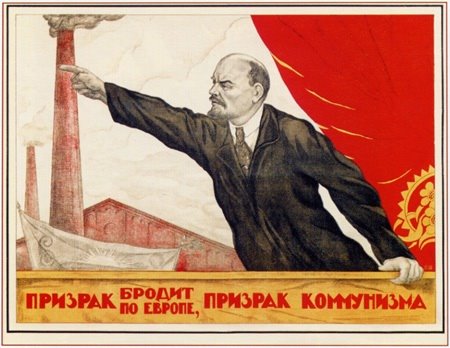
Back in the USSR


In the past when I've studied communism, I feel like discussions of it have been marred by people's assumptions about how it works. In high school I even had a teacher who banned the use of the word communism until he finally caved and made us read part of The Communist Manifesto. Fortunately that's not the case at the University of Michigan and the discussions we've had in class have been elucidating as opposed to frustrating. The only topic I get really frustrated with is how much we discuss the Soviet Union only in terms of Stalin and don't focus on some of the better Soviet actions. 

Lenin with the opening of The Communist Manifesto in Russian.
But did it really stick?
By no means is this post meant to condone any of Stalin's actions, and I sincerely hope that no one is going to excuse killing of 25 million people under his regime. But one thing that really stuck out to me in lecture was that one of the problems was that it took place in Russia, which had only been serf-free since 1861, meaning that this led to a very rushed and corrupted implementation of communism. As a result, it never really became communism, but more Stalinism (or possibly in Zizek's words, a perversion of communism).


But this got me thinking: Can we truly criticize the Soviet Union for not implementing communism properly? And what I mean by this is has America truly stuck to the political philosophies this country was founded on? And while I don't want to say "is there a way to pardon the Soviet Union?", maybe what I want to say is "is there a way to understand better what exactly happened to Soviet communism?". 


Despite how diluted Marxism may have been in the Soviet Union, 
somehow a taste of it found its way into children's cartoons. 
Note the cross hanging from one of the bees (who is in this case the "bad guy"). 
Picture found here, but if you want to see for yourself you can watch it here. 
One of the philosophies that still permeates our culture today is how much Locke has influenced our government. And what were some of Locke's main tenets? One of the most basic ones that stands out the most is the protection of life, liberty, and property, which have all found their way into the Declaration of Independence, a founding document for this country. To some extent we can argue that these ideas are protected under our legislation today. However, we can clearly see how this ideology doesn't fully continue to hold up. 

Malcolm X provides a very good example as to how Locke's ideas weren't completely preserved during the Civil Rights Movement, and this carries over to the modern era as well. He says, "No, I'm not an American. I'm one of the 22 million black people who are the victims of Americanism. One of the 22 million black people who are the victims of democracy, nothing but disguised hypocrisy. So, I'm not standing here speaking to you as an American, or a patriot, or a flag-saluter, or a flag-waver--no, not I. I'm speaking as a victim of this American system. And I see America through the eyes of the victim. I don't see any American dream; I see an American nightmare" (X 3). For Malcolm X, the American system failed him. Judging by his description of his experience in this passage and others, America did not do a good job of preserving his life and liberty, and he can't even identify as American because of this. This doesn't sound like America is sticking to its Lockeian principles at all. The Civil Rights movement helped expose just how terribly this system which emphasized "liberty" was actually treating its citizens. 
Yuri Kochiyama on Malcolm X in "Freedom is a Constant Struggle," which speaks to many of the institutional issues he faced.

These types of issues concerning liberty and property still continue today. In modern society there is still institutional racism and other forms of oppression. There is still racial profiling, between stop and frisk policies in New York City to the immigration laws in Arizona, that impede on the right to liberty of certain segments of the population. As for the pursuit of property, here we get some pretty clear statistics: the wage gap. 

Found here


 This shows that there is still institutional racism, and although the details of how this works might be made intentionally unclear in society, these statistics point to the fact that no, not everyone in America has been given an equal opportunity to property, and in fact many people are "victims of America".

Now, switching gears to the second question: how can we understand Soviet communism? It's very hard to look to Stalin for this because of how much paranoia and corruption were perpetrated throughout his reign. However, what about later leaders? Obviously other administrations faced their own corruption, but perhaps things actually improved over the course of the Soviet Union's seventy years. Khrushchev made his Secret Speech which not only condemned many of Stalin's egregious acts, but also showed Khruschev's attempt to return to Leninism, which was much closer to Marx that Stalinism ever was. At the end of the Soviet Union we also have Gorbachev with his glasnost' and perestroika, or opening up and restructuring. These probably don't seem very connected to Marxism at all; however, Stalinism had been a period of intense oppression, which goes against Marxism because Marx posited that communism was a natural process, and yet here Stalin was trying to use force to get it to work. Gorbachev's policies show the possibility of a return to this more natural progression, or at least an attempted return considering the Soviet Union collapsed shortly thereafter. 

I don't think I can emphasize enough how terrible many of the things the Soviet Union did were. However, the Soviet Union was very young and as a nation it did not have a lot of time to mature, and we can only guess what it would have been like if it had. If we're going to discuss how the Soviet Union did not hold completely to Marxism in its first few years of existence, then we have to examine our own history, and although the death tolls as a result of oppression in this country are probably not as high as those under Stalin, we can clearly see that throughout American history and even know, we have our own ideological problems to admit to.

Tuesday, November 27, 2012

Collective Action Problems Galore


Earlier in the semester we learned that collective action problems are situations in which individuals have an incentive not to cooperative in group-work if they believe others will cooperate instead. These problems often result in free riding and prisoner’s dilemma type situations, as one party is only looking out for his or her own self interests. Since this lecture back in early October, I have encountered collective action problems in all three of my other classes.

This video clip from a Dilbert episode explains a prisoner's dilemma: 


More recently, in my American Government class, we spent a great deal of time discussing collective dilemmas, or situations that arise when the goals of two groups differ. These are fairly common, especially in politics when people must work together to accomplish a single goal. There are three different types of collective dilemmas. The first type is a principal-agent problem, or a problem that arises when there is a conflict of interest between two groups or individuals who must make a decision. This may occur when one party has information that the other is lacking, or when the two parties disagree on what action should be taken. The second type of a collective dilemma is a coordination problem. These types of problems occur when one does not know what the other party is going to do, yet still needs to negotiate a problem. The example my Professor gave here was two cars that are about to crash. Finally, the third types of collective dilemmas are collective action problems, which we learned about in Poli Sci 101.


In my American Government class, we learned about collective dilemmas when we read “The Theory of Groups and Organizations,” a chapter in Mancur Olson’s The Logic of Collective Action: Public Goods and the Theory of Groups. Olson thought that small groups were the answer to collective-action problems. Larger groups will have higher initial costs and they will not be able to further their common interests as much as a small group. Small groups, however, have fewer opportunities to free ride, and individuals get a larger “piece of the pie” in the end (Olson 28). 

In my Environment 201 class, we also learned about similar situations with Garret Hardin’s Tragedy of the Commons. Many people pollute because they feel that they will not make a big enough impact to make a considerable difference. Since they think others are recycling, they feel it is unnecessary for them to contribute. This obviously becomes an issue when everyone thinks with this mindset.


The approaches I learned about in my Environment class and Poli Sci 101 were the most similar. Both suggest that equal cooperation is the most logical solution. However, in my American Government class, Olson believes that free riding is inevitable, and the only way to prevent free riding is to eliminate the opportunity by spreading the responsibility among fewer individuals.

Image by James Yang

A common, real life example of a collective action problem, especially for students, is working on a group project. With an extremely high incentive to free ride, what is the most efficient approach to assure equal participation? Is it better when professors make group members complete task-lists and peer evaluations to ensure an equal division of work, or is it better to just limit group sizes?  Is forcing an equal level or cooperation enough, or is Olson correct in saying that the only way to truly eliminate the possibility of free riding to eliminate large groups? Personally, after working on many group projects, I have found that free riding still occurs in small groups, and it can be very difficult and uncomfortable to give a fellow classmate a poor ranking on a peer evaluation.


The grading system in Poli Sci 101 is a bit untraditional in that students are able to decide which assessments to complete, and how heavily each of these assignments are weighted. There are four options: conventional essays, blogging, a solo new media project, and a group project. Each student is given six units of kapital to invest in whichever assignment, or combination of assignments, he or she chooses. A unit of kapital acts a multiplier. For example, since each of the four assignments is worth 4,000 points, if I were to invest three units of kapital in the group project, my final score would be multiplied by three.

When I was deciding how to invest my kapital for this class, I chose not to participate in a group project. My decision was partially based on my lack of creativity, but also because I feared that it would result in a collective action problem. If one of my group members had less kapital invested in our project, how could I be convinced he or she would be completely dedicated? It would also not be fair to expect the same amount of work from each group member if one is receiving significantly fewer points.
Image from SaltMangoTree.net

After reflecting on the solutions that Olson and Hardin offer, I realized that when applied to group projects, collective action problems still exist; small groups sizes and an attempt to mandate equal participation still do not prevent free-riding. However, if everyone is made aware of exactly how much each person is able to benefit from the work, than the work can be divided accordingly. If I know that my partner can only earn 4,000 points from our project, and am trying to earn 24,000 points, I would take on more of the work. In this case, my partner is not free-riding because I am receiving a larger benefit. While I originally thought the use of kapital may be result in free-riding, I now think it could be an alternative, possibly even more efficient, solution to collective action problems.