In the past when I've studied communism, I feel like discussions of it have been marred by people's assumptions about how it works. In high school I even had a teacher who banned the use of the word communism until he finally caved and made us read part of The Communist Manifesto. Fortunately that's not the case at the University of Michigan and the discussions we've had in class have been elucidating as opposed to frustrating. The only topic I get really frustrated with is how much we discuss the Soviet Union only in terms of Stalin and don't focus on some of the better Soviet actions.
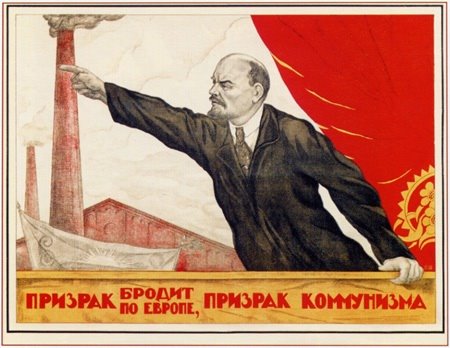 |
| Lenin with the opening of The Communist Manifesto in Russian. But did it really stick? |
But this got me thinking: Can we truly criticize the Soviet Union for not implementing communism properly? And what I mean by this is has America truly stuck to the political philosophies this country was founded on? And while I don't want to say "is there a way to pardon the Soviet Union?", maybe what I want to say is "is there a way to understand better what exactly happened to Soviet communism?".
 |
| Despite how diluted Marxism may have been in the Soviet Union, somehow a taste of it found its way into children's cartoons. Note the cross hanging from one of the bees (who is in this case the "bad guy"). Picture found here, but if you want to see for yourself you can watch it here. |
Malcolm X provides a very good example as to how Locke's ideas weren't completely preserved during the Civil Rights Movement, and this carries over to the modern era as well. He says, "No, I'm not an American. I'm one of the 22 million black people who are the victims of Americanism. One of the 22 million black people who are the victims of democracy, nothing but disguised hypocrisy. So, I'm not standing here speaking to you as an American, or a patriot, or a flag-saluter, or a flag-waver--no, not I. I'm speaking as a victim of this American system. And I see America through the eyes of the victim. I don't see any American dream; I see an American nightmare" (X 3). For Malcolm X, the American system failed him. Judging by his description of his experience in this passage and others, America did not do a good job of preserving his life and liberty, and he can't even identify as American because of this. This doesn't sound like America is sticking to its Lockeian principles at all. The Civil Rights movement helped expose just how terribly this system which emphasized "liberty" was actually treating its citizens.
Yuri Kochiyama on Malcolm X in "Freedom is a Constant Struggle," which speaks to many of the institutional issues he faced.
These types of issues concerning liberty and property still continue today. In modern society there is still institutional racism and other forms of oppression. There is still racial profiling, between stop and frisk policies in New York City to the immigration laws in Arizona, that impede on the right to liberty of certain segments of the population. As for the pursuit of property, here we get some pretty clear statistics: the wage gap.
 |
| Found here |
Now, switching gears to the second question: how can we understand Soviet communism? It's very hard to look to Stalin for this because of how much paranoia and corruption were perpetrated throughout his reign. However, what about later leaders? Obviously other administrations faced their own corruption, but perhaps things actually improved over the course of the Soviet Union's seventy years. Khrushchev made his Secret Speech which not only condemned many of Stalin's egregious acts, but also showed Khruschev's attempt to return to Leninism, which was much closer to Marx that Stalinism ever was. At the end of the Soviet Union we also have Gorbachev with his glasnost' and perestroika, or opening up and restructuring. These probably don't seem very connected to Marxism at all; however, Stalinism had been a period of intense oppression, which goes against Marxism because Marx posited that communism was a natural process, and yet here Stalin was trying to use force to get it to work. Gorbachev's policies show the possibility of a return to this more natural progression, or at least an attempted return considering the Soviet Union collapsed shortly thereafter.
I don't think I can emphasize enough how terrible many of the things the Soviet Union did were. However, the Soviet Union was very young and as a nation it did not have a lot of time to mature, and we can only guess what it would have been like if it had. If we're going to discuss how the Soviet Union did not hold completely to Marxism in its first few years of existence, then we have to examine our own history, and although the death tolls as a result of oppression in this country are probably not as high as those under Stalin, we can clearly see that throughout American history and even know, we have our own ideological problems to admit to.

No comments:
Post a Comment